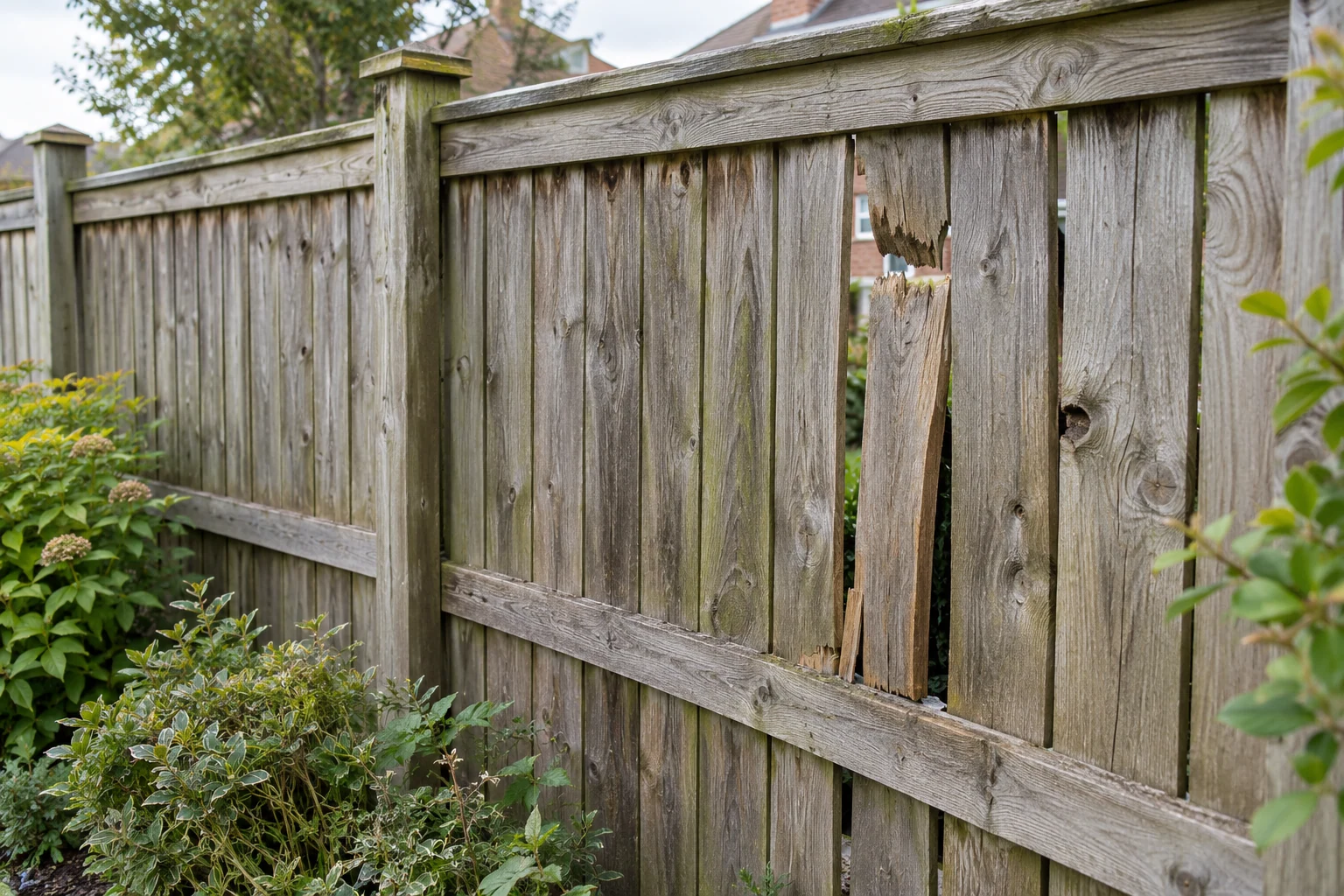
Identify the address and the damaged section
Docklands is a broad location description, so include the street address, postcode and building or development name where useful. Give the entrance used to reach the fence. Explain whether it serves a private garden, communal area or business premises.
Describe the visible fault: a broken panel, loose connection or moving support. Mention whether one bay or several sections are affected. You do not need to diagnose hidden damage before enquiring, and a description can begin the conversation without close-up photographs.
Keep away from unstable components
Do not push the fence, dismantle fixings or climb over a damaged section to show the problem. Take photographs only from a safe position. If the damage affects a route people use, explain that access concern when arranging the assessment.
Our wind-damage guide provides background for enquiries after strong winds. Mention repeated movement or earlier repairs, where known, so the discussion includes the history of the fault. A new panel should not be assumed to resolve every reason a boundary has moved or failed.
Explain what supports the fence
Say whether the fence stands in ordinary ground or is fixed to a wall, terrace, deck or other structure. Describe nearby changes in level or water and the intended function of the boundary. These details matter before an ordinary garden-fence repair can be considered suitable.
Screening should not be assumed to provide protective guarding. If the damaged structure has a specialist role, supply available drawings or requirements and identify who is responsible for them. Suitability and any necessary specialist assessment must be established before a repair method or capability is confirmed.
Separate infill damage from support problems
Our panel replacement guide covers damaged infill, while our post repair guide addresses support-related enquiries. Ask which surrounding components need assessment and whether retained sections can accept the proposed new connections. A panel that fits the opening does not establish the condition of its supports.
Mention gates or other items attached to the affected section. Explain any change in their operation without forcing them. The quotation should identify new and retained components separately, including any work to an opening that forms part of the repair.
Compare the limits of repair and replacement
Ask what the proposed repair would restore and which concerns remain outside its scope. Renewing one component does not renew the whole run. Where the condition of retained parts is uncertain, the proposal should identify further assessment rather than assume a limited repair resolves everything.
Our repair or replace guide helps compare those choices. The Docklands installation page covers new and replacement runs. If both options are requested, compare defined scopes with materials, removal and exclusions clearly stated instead of judging different jobs by headline prices alone.
Arrange access to the work area
Describe the full route from unloading to the damaged fence, including gates, stairs, narrow turns and occupied or shared spaces. Identify who supplies keys and whether attendance needs an appointment. Do not move unstable fencing to make the route easier before the access concern has been discussed.
Our Docklands overview brings together the location and site questions. Confirm parking, loading and permissions with the relevant property contact. Access from adjoining land or use of communal space for materials needs a separate agreement rather than being inferred from public visitor access.
Agree the finish and surrounding work
New materials may differ from retained fencing in colour, texture and dimensions. Discuss what can reasonably be matched and how the repaired section will connect to the older run. If a uniform appearance matters, explain that before deciding on a limited repair.
Point out planting, surfaces, equipment and known services close to the work. Ask how preparation, removed components, foundations and disposal are treated. For business or managed property, the Docklands commercial page covers operating requirements and the approval route for changes to the agreed job.
Request a free repair quotation
Call 020 3797 3058 or request a free quote with the full address, description of the damage and safe photographs if available. Include the supporting surface and any specialist function of the boundary. Capability, availability and the next assessment step will be discussed for the actual property.
Use our quotation checklist to review retained parts, new work, exclusions and applicable terms. No fixed emergency response time is promised. A defined repair scope should explain the work being undertaken without implying structural or waterside expertise that has not been confirmed.
Frequently asked questions
What should I send for a Docklands repair enquiry?
Provide the full address, access entrance, visible damage and supporting surface. Include photographs only where they can be taken safely and describe any specialist function of the boundary.
Can a fence on a terrace be repaired like a garden fence?
Not automatically. The supporting construction, fixings and intended function need review before a suitable method and capability can be confirmed.
Does a panel replacement restore the whole fence?
No. Ask the quotation to distinguish new components from retained parts and identify any concerns outside the proposed repair.