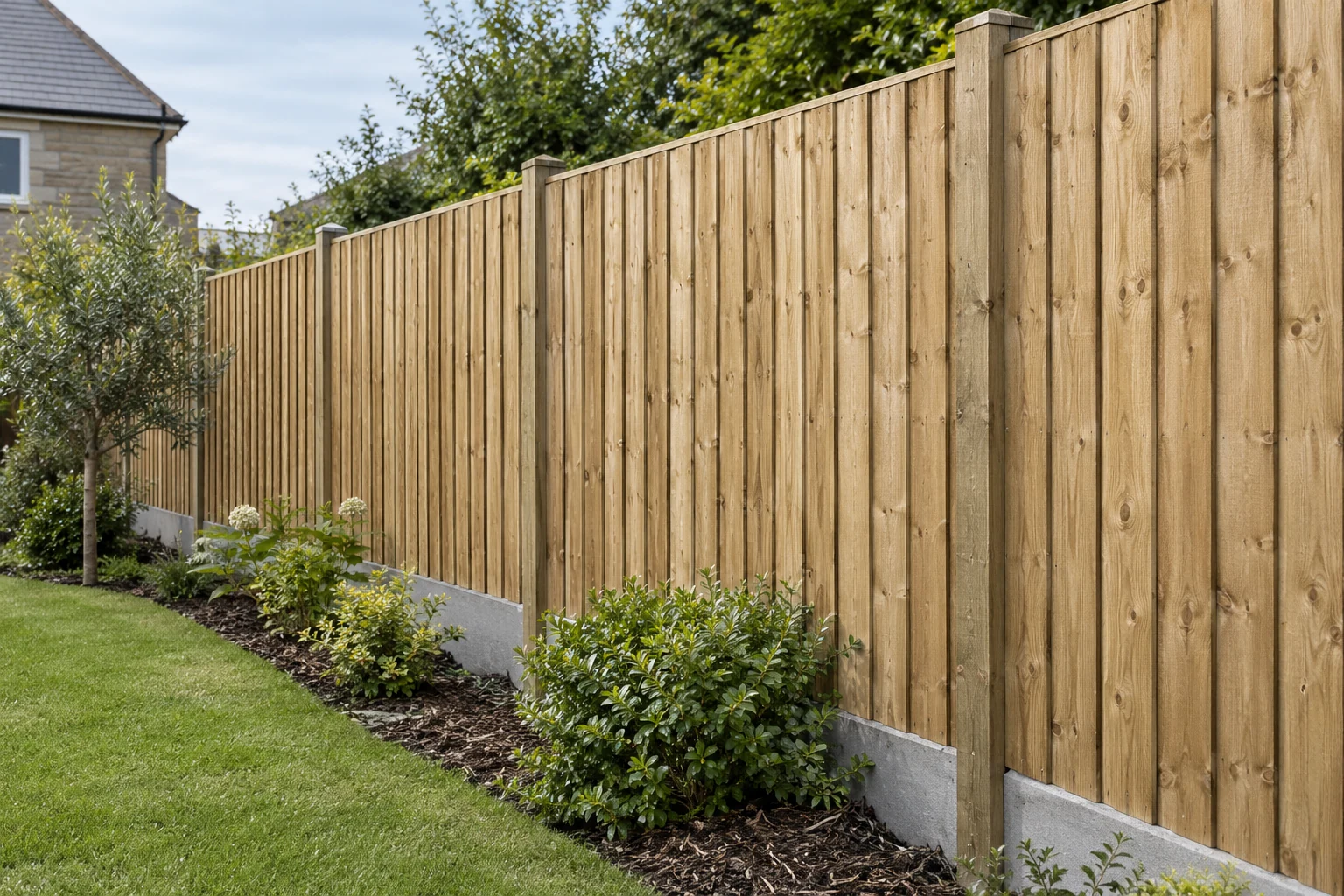
One style, several familiar names
Closeboard, feather-edge and featherboard are terms you may encounter when discussing overlapping vertical timber boards. For your quotation, the important details are how the fence is constructed, the dimensions and the supporting posts, rather than the name alone. A ready-made panel and a fence assembled along rails on site may produce a related appearance but involve different installation arrangements.
Tell us whether you are replacing an existing closeboard fence or choosing a solid style for the first time. A photograph of the boundary and an approximate length help start the discussion. The final construction and quantities need to reflect the actual site, including corners and changes in level.
Where closeboard fencing can work well
This style is worth discussing when you want a more enclosed garden boundary or a clear visual screen beside a patio. Unlike an open picket arrangement, the overlapping boards form a largely solid face. The effect still depends on the finished height, the position of the viewer and any differences in ground level between properties.
Think about the view from both sides. Posts and rails may be more visible on one face, depending on the system selected. If appearance from an adjoining garden matters, raise that before the specification is finalised. The same applies where several different fence styles currently meet at a corner.
Plan the supports and the ground line
Panels or boards are only part of the installation. Posts, rails, fixings and any gravel boards need to work together. An existing post should not be kept solely because it appears straight from a distance. Its condition and suitability for the proposed fence need assessing, particularly when the old fence has moved or deteriorated.
Ground levels can affect the shape of the finished run. A sloping boundary may need a stepped or separately detailed arrangement. Explain whether gaps beneath the fence matter to you, and point out paving, tree roots or planting close to the line. Do not cover lower timber with soil or assume that every installation detail suits direct ground contact.
Exposure and privacy are separate questions
A solid screen can provide visual separation, but it also presents a substantial surface to the wind. The supporting structure and fixing arrangement should suit the setting. Choosing heavier-looking boards alone does not establish that a fence is appropriate for an exposed position.
If wind exposure is a concern, describe the setting and the failure of any previous fence. We can discuss options at the survey. An alternative with openings may create a different balance of screening and appearance, but no style should be sold as storm-proof without a properly supported specification.
What your closeboard quotation should explain
Check the proposed height, length, construction, post material and finish. Ask whether gravel boards, removal of old fencing, waste disposal and any preparation are included. The specification should also describe what will happen at corners, ends and changes in level, where an otherwise simple run can need additional work.
Access affects delivery and handling. Mention narrow side passages, steps and any route through the property. If materials or installation require access from next door, agree that separately with the relevant owner before a date is booked. A quotation should make these assumptions clear rather than leave them to installation day.
Care and future repairs
Ask for the care instructions appropriate to the timber treatment and finish actually supplied. Painting or staining is a separate choice and should follow the product guidance. Keep planting manageable around the boundary so the condition of the timber and supports can be checked.
If only part of an existing closeboard fence has failed, a repair may be possible. New timber is unlikely to look exactly like older weathered boards at first. Discuss whether a local repair or replacement of a complete section will give the most useful result for the condition and appearance you want.
Request a closeboard fencing quotation
Call 020 3797 3058 with your postcode and approximate fence length. We offer free quotations and can discuss a site survey to establish the specification. If you are comparing styles, explore overlap fencing or slatted fencing before deciding. You do not need to choose the final product before making an enquiry.
Frequently asked questions
Is feather-edge different from closeboard?
The terms commonly describe the same family of overlapping vertical-board fencing. Ask for the actual construction and dimensions in the quotation, since terminology alone does not specify a complete fence.
Can closeboard fencing follow a slope?
The arrangement needs to be designed around the ground levels. Discuss the proposed stepped or detailed finish and any gaps at the base before agreeing the work.
Can existing posts be reused?
Possibly, if their condition, spacing and suitability are confirmed. Reusing an unsuitable post can leave the new fencing with the same underlying weakness.