Start with the problem, not the panel count
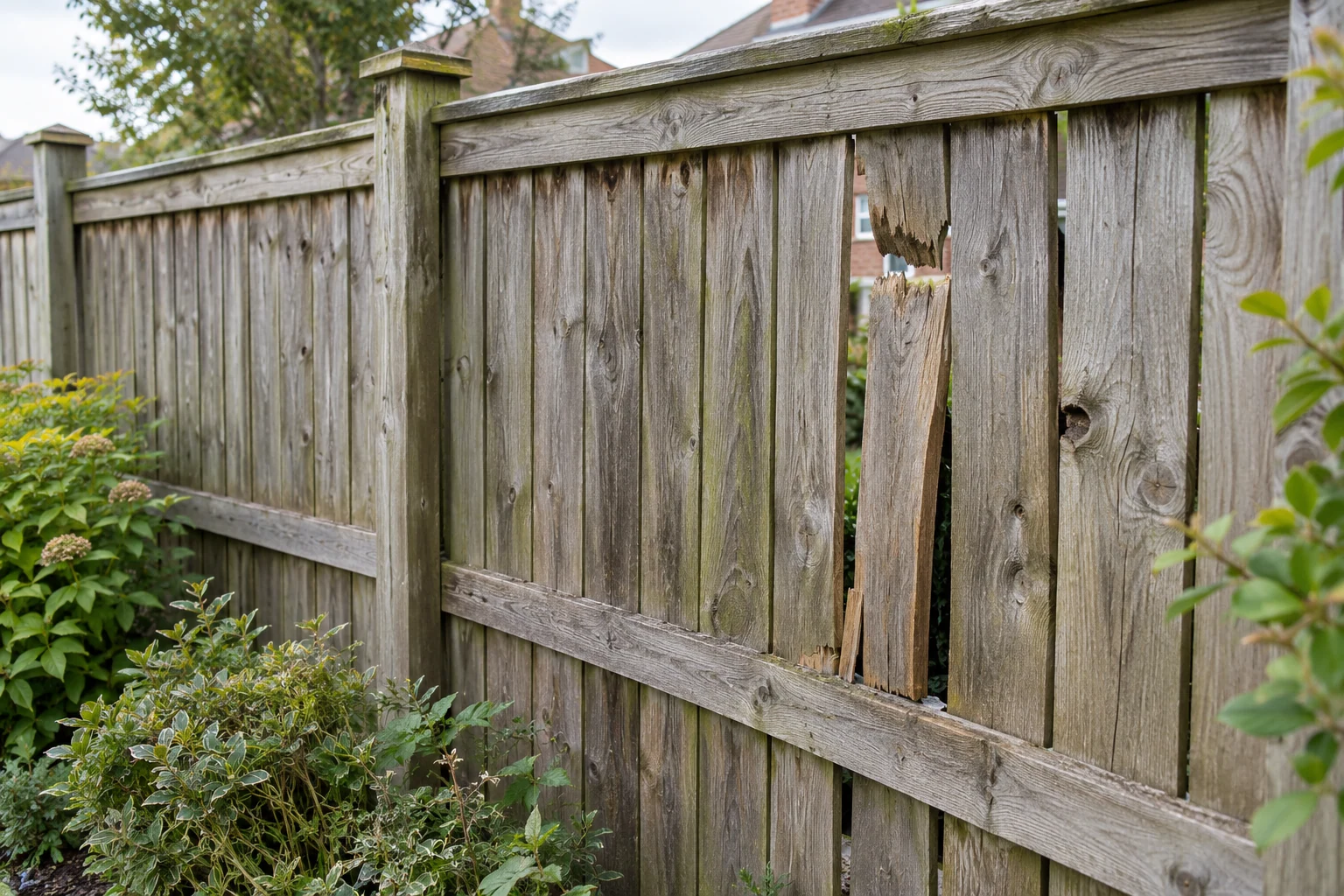
Describe what you have noticed: a panel has come loose, a post is leaning, several boards are damaged or a gate no longer closes as it used to. Mention when the change appeared and whether the same section has needed attention before. These details help frame an assessment without requiring you to identify the cause.
Do not push or pull an unstable fence to test it. Keep clear of loose sections and take photographs only from a safe position. If you cannot inspect the boundary safely, explain that when you enquire.
When a local repair may be worth considering
A repair may be an option when damage is confined to a limited area and the parts being retained are suitable for continued use. That could mean considering one panel, selected boards, fixings or a particular post. The useful question is whether the repair addresses the problem while leaving a coherent, serviceable fence.
Ask what the assessment has found and which components the proposal would retain. A description such as “repair the fence” is too broad to compare with a quotation that identifies the affected panel, support and connections. Our fence repairs page explains the available starting points for an enquiry.
Look at the supports as well as the infill
The visible panel is only part of the fence. A replacement panel needs suitable support and compatible connections. If a post or its foundation is the source of movement, changing the panel alone may not resolve the issue.
Equally, a damaged post does not prove that every panel must be replaced. Ask whether the adjoining parts can be retained and what could affect that decision once work begins. Our fence post repairs page covers the questions to raise when movement appears to be concentrated around a support.
When a replacement section deserves comparison
Ask about a larger replacement section if damage affects several adjoining components, the same area has required repeated repairs or the retained fence would still have significant unresolved problems. The assessment should explain why the proposed length is appropriate rather than simply defaulting to the whole boundary.
For example, if one bay is visibly damaged but neighbouring posts also need attention, ask for the work to be described as a connected section. This is a decision example, not a claim about a completed project or a diagnosis of your property.
A complete run may also change the outcome
Sometimes the decision includes more than restoring the existing fence. You may want a different appearance, a revised layout or a style with different sightlines. Those preferences can make a new run worth comparing even when a limited repair is possible.
Separate those improvements from necessary repairs in the discussion. This makes it easier to see what you would pay to restore the current arrangement and what you would pay to change it. Explore fence styles if you are considering a different result, and discuss any proposed height or boundary changes before treating them as agreed.
Matching new parts to the existing fence
A replacement section may look different from weathered timber even when it has a similar design. Dimensions, board arrangement and the available products also affect how closely old and new sections can match. Describe whether a consistent appearance is essential or whether retaining usable material is your priority.
Ask to confirm the proposed replacement style and how it meets the adjacent fence. For panel-only work, our fence panel replacement page explains what information is useful before choosing a replacement. Avoid buying a panel solely because its advertised size appears close to the existing one.
Compare clearly defined options
If repair and replacement are both feasible, ask for the two scopes to identify retained parts, new components, removal and the finished result. Compare the project totals and any uncertainties alongside the price. A cheaper option is harder to judge if it leaves the next likely repair unexplained.
Use the fencing costs guide to understand the parts of the job behind each figure. Ask what guarantee applies to the new work and what remains outside its scope, especially where older materials are kept. Do not assume that a repair creates a new guarantee for the whole existing fence.
Make the enquiry practical
Tell us your postcode, the approximate extent of the damage and whether the property is a home, rental or business premises. Explain how the fence can be reached and whether a shared access route is involved. If someone else needs to authorise the work, flag that before an installation date is discussed.
You can request a free quote without deciding in advance that replacement is necessary. Describe the problem and the result you need. Call 020 3797 3058 to discuss an assessment and the information that would help compare your options.
Frequently asked questions
Does a leaning fence always need replacing?
No single answer fits every fence. The cause of the movement and the condition of posts, foundations and adjoining sections need assessment before a repair or replacement scope can be recommended.
Can you replace just part of a fence?
A partial replacement may be possible where the retained fence is suitable and the new section can be integrated. Ask for the limits of the replacement and any matching differences to be explained.
Will photos be enough to confirm a repair?
Photos can help explain visible damage, but they may not show the condition of supports, buried foundations or access. Further assessment may be needed before confirming the work.