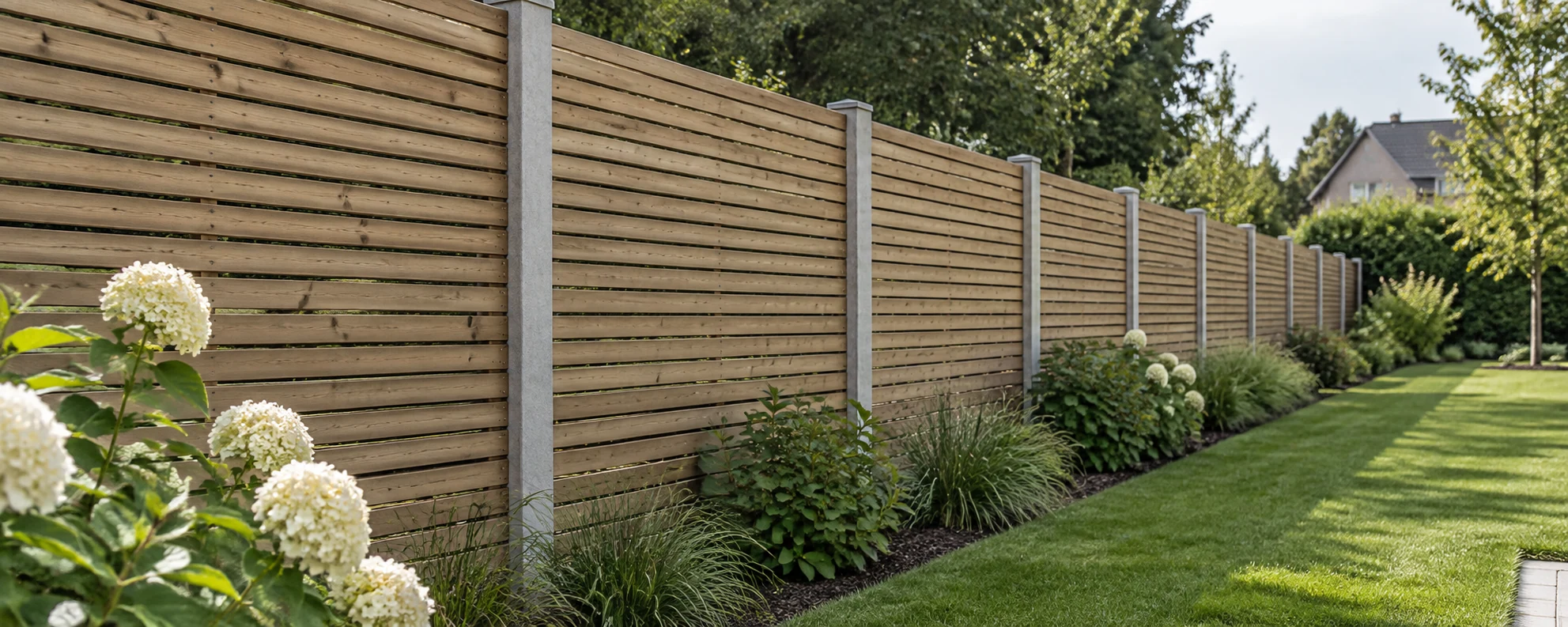
Identify the view you want to reduce
Stand in the part of your garden where privacy matters most, such as a seating area or a doorway, and describe the view you want to interrupt. Is the concern a nearby path, a neighbouring patio or an elevated window? These are different sightlines and may call for different discussions.
A taller-looking panel in a photograph is not proof that it will screen the view at your property. Record the position of the space you want to use and explain the relative levels. You do not need to enter neighbouring land or photograph private interiors to describe the concern.
Compare solid fence constructions
If your main aim is to reduce direct views through the boundary, start by discussing a solid-style panel or board arrangement. Our closeboard fencing page explains one of the established style options. Confirm the actual product construction and how the proposed run meets the ground, posts and adjoining sections.
Think about the whole result, including the visual weight of a long fence seen from indoors. A style that works well beside a seating area may feel different along every edge of a small garden. Use the proposed layout to decide where screening is most useful.
Look carefully at slatted fencing
Slatted is a broad description, not a fixed level of privacy. Single rows of separated slats leave openings; other arrangements use offset or overlapping elements to change the view through them. Jacksons' slatted panel guide illustrates these differences within its own range. Those examples do not establish that a particular product is supplied by this business.
When discussing slatted fencing, ask to see the proposed construction rather than relying only on its name. Consider the view straight through the fence and at an angle. Confirm which options are available and suitable before treating a sample image as the agreed specification.
Treat trellis as an open feature
Trellis has visible openings and should not be specified as an opaque screen on its own. It may suit a garden where a more open boundary or a decorative section is wanted. Our trellis fencing page gives a starting point for discussing that appearance.
If you intend to combine planting with the fence, explain that plan at the outset. Do not assume that planting will provide immediate or year-round screening, or that an existing fence can support additional attachments. Discuss the proposed arrangement and its care requirements separately.
Check views from more than one position
Consider seated and standing views, the path through the garden and the view from the house. A decision based only on a photograph taken directly in front of a panel can miss the way the fence will be experienced day to day.
Ask the contractor to describe the expected finished arrangement, including changes in level and any spaces around openings. If privacy is needed only in one area, explain that rather than assuming the entire boundary needs the same treatment. Any suggested solution still needs to suit the actual site.
Confirm the complete height before choosing
Include the whole proposed assembly when discussing height, not just the labelled panel size. Explain whether gravel boards, trellis or a wall form part of the arrangement, and whether the ground changes level along the boundary.
Our fence height and planning guide explains the checks to make before settling on a specification. Do not assume that adding a decorative top is outside planning considerations or that an existing neighbouring fence establishes what you can build. Resolve site-specific questions with the local planning authority where needed.
Keep the practical requirements in view
Privacy is one part of the brief. Also describe access, gate openings, the appearance you want and how you intend to care for the fence. If supports are to be reused, confirm whether they are suitable for the proposed change rather than assuming that a new style is a panel-only swap.
Our timber fence maintenance guide helps you prepare questions about care. For the project total, use the fencing costs guide to separate the style choice from supports, removal and access. This makes it easier to compare two options that achieve different results.
Turn your preferences into a quotation request
Tell us your postcode, approximate fence length and which part of the garden you want to screen. Describe whether you prefer a solid or more open appearance and mention any known height or access restrictions. If you have reference images, explain what you like about them rather than assuming an exact match is available.
Call 020 3797 3058 or request a free quote to discuss the options. The aim is a clearly specified fence that responds to your property and priorities, with realistic expectations about the view it can screen.
Frequently asked questions
Does slatted fencing provide full privacy?
It depends on the actual arrangement and viewing angle. Gaps in a single row allow views through; other constructions can offer more screening. Confirm the proposed product rather than relying on the word slatted.
Will a higher fence block every overlooking view?
Not necessarily. The position and elevation of the viewpoint matter. Discuss the sightline you want to screen and check the permitted arrangement before choosing a height.
Can I add trellis to improve screening?
Discuss the total height, support and intended effect first. Trellis has openings and should not be treated as a solid privacy panel or an automatic exemption from planning checks.